

Visa & Immigration

Visa & Immigration services
Generally, a foreign citizen who wishes to enter the Kingdom of Thailand is required to obtain a visa from a Royal Thai Embassy or a Royal Thai Consulate-General. However, nationals of certain countries do not require a visa if they meet visa exemption requirements as follows:








Thailand visa policy
Generally, a foreign citizen who wishes to enter the Kingdom of Thailand is required to obtain a visa from a Royal Thai Embassy or a Royal Thai Consulate-General. However, nationals of certain countries do not require a visa if they meet visa exemption requirements as follows:
-
they are nationals of countries which are exempted from visa requirements when entering Thailand for tourism or short term business engagements purposes. Such nationals will be permitted to stay in the Kingdom for a period of not exceeding 60 days.
-
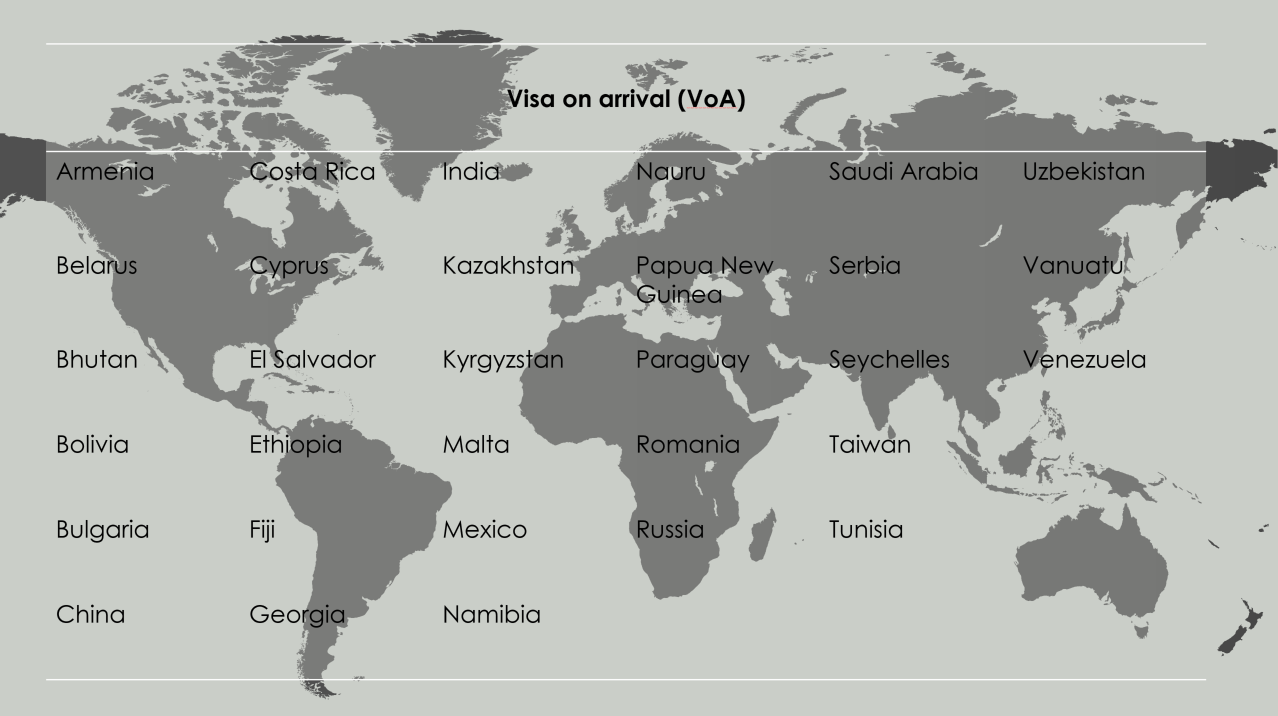
Nationals of certain countries may apply for visa upon arrival in Thailand. Travellers with this type of visa are permitted to enter and stay in Thailand for a period of not exceeding 15 days. For more information, please see Summary of Countries and Territories entitled for Visa Exemption and Visa on Arrival to Thailand .
-
Since 1st January 2025, visitors from around the globe can apply for a Thai e-Visa through the official website www.thaievisa.go.th. While the Thai e-Visa system has been available for travellers in select locations, this marks a significant expansion, allowing applicants from any part of the world to complete the entire process online. However, if you are not eligible to e-visa platform click here to see Thai embassy location and eligible contries / territories.
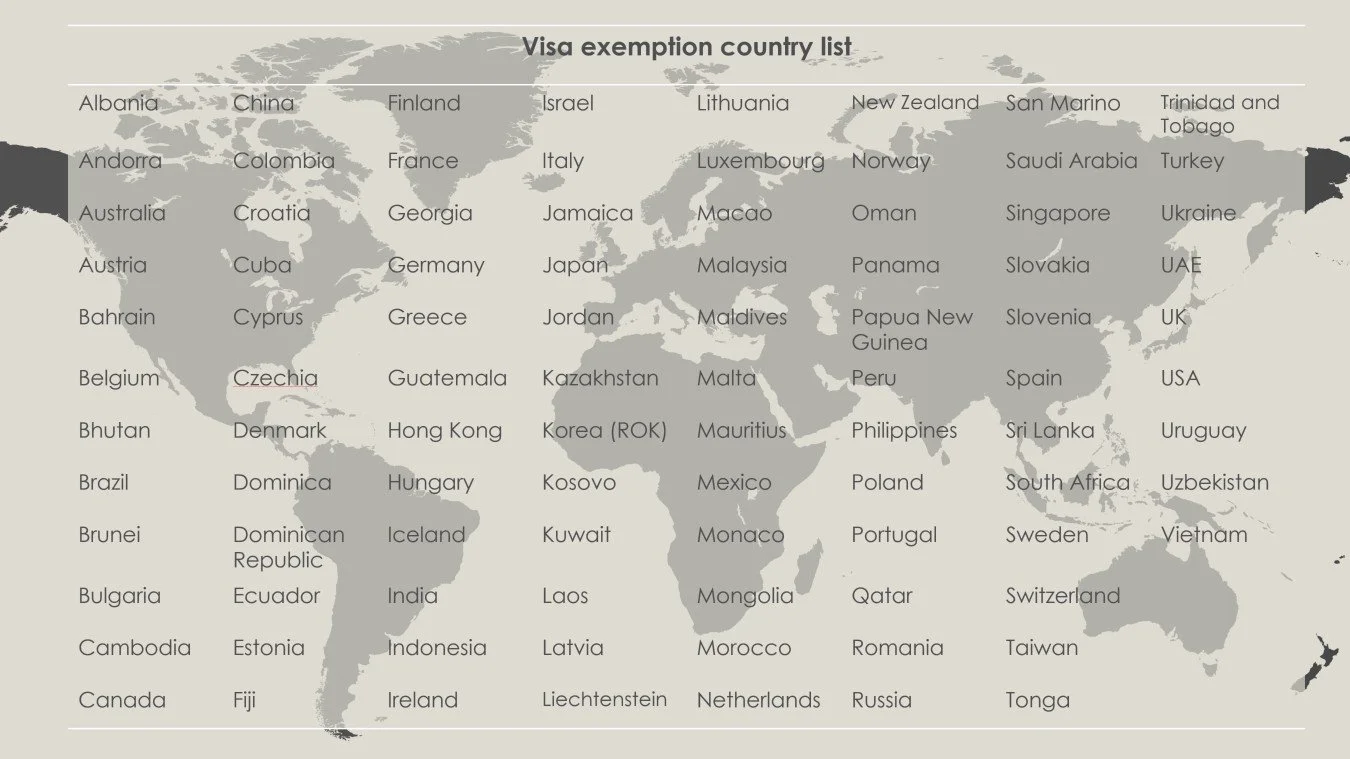
visa exemption
They are nationals of countries which are exempted from visa requirements when entering Thailand for tourism purposes. Such nationals will be permitted to stay in the Kingdom for a period of not exceeding 30 days. And they are nationals of countries which hold bilateral agreements with Thailand on the exemption of visa requirements.
Find out Summary of Countries and Territories entitled for Visa Exemption and Visa on Arrival to Thailand .
visa on arrival
need visa before enter to thailand
Since 1st January 2025, visitors from around the globe can apply for a Thai e-Visa through the official website www.thaievisa.go.th. While the Thai e-Visa system has been available for travelers in select locations, this marks a significant expansion, allowing applicants from any part of the world to complete the entire process online. However, if you are not eligible to e-visa platform click here to see Thai embassy location and eligible contries / territories.
-
To apply for a visa, a foreigner must possess a valid passport or travel document that is recognised by the Royal Thai Government and comply with the conditions set forth in the Immigration Act of Thailand B.E.2522 (1979) and its relevant regulations. In addition, the visa applicant must be outside of Thailand at the time of application. The applicant will be issued with a type of visa in accordance to his or her purpose of visit. For more information on types of visas and general requirements for each type of visa, please see Types of Visa and Issuance of Visa.
Nationals of certain countries are required to apply for a visa only at the Royal Thai Embassy or the Royal Thai Consulate-General in the applicant’s country of residence, or at the Royal Thai Embassy which has jurisdiction over his or her country of residence. Travellers are advised to enquire about authorised office for visa issuance at any Royal Thai Embassy or Royal Thai Consulate-General before departure.
E-visa:
Begin of 2025 “Thailand e-visa platform is available for all nationalities in every locations. However, applicants mush follow Consular guidance. Please visit Royal Thai Embassy specific location to find out visa checklist requirement. -
On the other hand, the period of stay is granted by an immigration officer upon arrival at the port of entry and in accordance with the type of visa. For example, the period of stay for a transit visa is not exceeding 30 days, for a tourist visa is not exceeding 60 days and for a non-immigrant visa is not exceeding 90 days from the arrival date. The period of stay granted by the immigration officer is displayed on the arrival stamp. Travellers who wish to stay longer than such period may apply for extension of stay at offices of the Immigration Bureau in Bangkok, located at Government Center B, Chaengwattana Soi 7, Laksi, Bangkok 10210, Tel 0-2141-9889 or at an Immigration office located in the provinces. For information on application for extension of stay, see the Immigration Bureau website at www.immigration.go.th
-
Travellers travellling from/through countries which have been declared Yellow Fever Infected Areas must acquire an International Health Certificate verifying the receiving of a Yellow Fever vaccination. For more information, please see List of Countries which are Declared Yellow Fever Infected Areas.
-
Royal Thai Embassies and Royal Thai Consulates-General have the authority to issue visas to foreigners for travel to Thailand. The authority to permit entry and stay in Thailand, however, is with the immigration officers. In some cases, the immigration officer may not permit foreigner holding a valid visa entry into Thailand should the immigration officer find reason to believe that he or she falls into the category of aliens prohibited from entering Thailand under the Immigration Act B.E. 2522 (1979).
Please note that the period of visa validity is different from the period of stay. Visa validity is the period during which a visa can be used to enter Thailand. In general, the validity of a visa is 3 months, but in some cases, visas may be issued to be valid for 6 months, 1 year or 3 years. The validity of a visa is granted with discretion by the Royal Thai Embassy or Royal Thai Consulate-General and is displayed on the visa sticker.
-
According to the Immigration Act of Thailand B.E. 2522 (1979), foreigners who fall into any of the following categories are prohibited to enter Thailand:
Having no genuine valid passport or document used in lieu of passport; or having a genuine valid passport or document used in lieu of passport without valid visa issuance by the Royal Thai Embassies, the Royal Thai Consulates-General or the Ministry of Foreign Affairs, with exception of those who meet visa exemption requirements. The terms and conditions of visa issuance and visa exemption are prescribed by the Ministerial Regulations.
Having no appropriate means of living following entry into the Kingdom.
Having entered the Kingdom to be employed as an unskilled or untrained labourer, or to work in violation of the Alien Work Permit Law.
Being mentally unstable or having any of the diseases stated in the Ministerial Regulations.
Having not yet been vaccinated against smallpox; or inoculated, or undergone any other medical treatment for protection against disease; and having refused to have such vaccinations administered by the Immigration Doctor.
Having been imprisoned by judgment of the Thai Court; or by lawful injunction or judgment of the Court of a foreign country, except for when the penalty is for a petty offence, or negligence, or is provided for as an exception by the Ministerial Regulations.
Having behaviour which could cause possible danger to the public; or having the likelihood of being a nuisance or constituting any violence to the peace, safety and security of the public or to the security of the nation; or being under warrant of arrest by competent officials of foreign governments.
Reason to believe that entry into Kingdom is for the purpose of being involved in prostitution, the trafficking of women or children, drug smuggling, or other types of smuggling which are against public morality.
Having no money or bond as prescribed by the Minister under Section 14 of the Immigration Act B.E. 2522 (1979).
Being a person prohibited by the Minister under Section 16 of the Immigration Act B.E. 2522 (1979).
Being deported by either the Government of Thailand or that of other foreign countries; or having been revoked the right of stay in the Kingdom or in foreign countries; or having been expelled from the Kingdom by competent officials at the expense of the Government of Thailand unless exemption is provided by the Minister on an individual basis.
Thailand visa category
By virtue of Section 9 of the Emergency Decree on Public Administration in Emergency Situations B.E. 2548 (2005) and Section 11 of the State Administration Act B.E. 2534 (1991), the entry to Thailand is permitted for particular persons in the exempted list. The list for non-Thai nationals includes the following:
-
Persons on diplomatic or consular missions or under International organizations, or representatives of
foreign governments or agencies performing their duties in Thailand, or any other persons in
international agencies, that the Ministry of Foreign Affairs gives permission pertaining to necessity, including their spouse, parents, or children.
Diplomats and Officials (D / F / NON F) (click here)
-
Non-Thai nationals who are spouses, parents, or children of Thai nationals.
-
Non-Thai nationals who have a certificate of residence, or have been permitted to take up residency in the Kingdom;
-
Non-Thai nationals who have a work permit or have been granted permission to work in the Kingdom in accordance with Thai laws, including their spouses or children;
Work permit holders or granted permission to work in Thailand (NON-B / IB / SMART Visa) (click here)
Spouses or Children or Work Permit Holders (NON-O) (click here)
Work permit holders – Religious / Missionary works (NON-R) (click here)
Work permit holders – Volunteers or NGOs (click here)
Elite – Thailand Elite Card Member (Elite) (click here)
APEC – APEC Card Holder (APEC) (click here)
-
Non-Thai nationals who are students of educational establishments in Thailand approved by Thai authorities,
including their parents or guardians, except for students of non-formal schools in accordance with laws
on private schools or of any other similar private educational establishments;
(9) Students (NON-ED) (click here)
(9) Students (Parents / Guardians) (NON-O)
(11) Studying, training, or do internship or attending religious activities in Thailand (NON-ED) -
Non-Thai nationals who need to receive medical treatment in Thailand, including their accompanying persons,
except for treatment for COVID-19;
(10) Foreigner with Medical Appointment (TR-MT) (click here)
(10) Accompany person of foreigners with Medical Appointment (NON-O) -
On 22 November 2016, the Cabinet of Thailand approved new scheme which allows nationals from 14 countries to stay in Thailand for the maximum period of 10 years. In order to enjoy this new scheme, the applicants must apply for Non-Immigrant Visa “O-X” (Long Stay) or so called Non-O-X Visa at the Royal Thai Embassy/Royal Thai Consulate-General (when applying outside Thailand) or the Immigration Bureau (when applying in Thailand).
The purpose of this type of visa is to promote long stay for foreign traveler to Thailand. Nationals from 14 countries with the age of 50 years old or over can apply for a multiple-entry Non-O-X visa and stay in the Kingdom for the maximum period of 10 years
(5 years according to visa validity plus an extension for another 5 years). The visa fee is 10,000 Baht (or local currency equivalent if applying outside Thailand).In accordance with the Notification of the Ministry of Interior Re: Authorization for Certain Groups of Aliens to Enter the Kingdom on an exceptional case on Long-Stay Purpose in accordance with the Cabinet Resolution, dated 22 November B.E. 2559 (2016) (effective from 11 August 2017), foreigners with the following qualifications and supporting documents may apply for a multiple-entry Non-O-X visa:
Further information click here.
-
(11) Visa exemption scheme (Exempt) (click here)
(11) Medium Term Visitor – Tourist visa (TR) (click here)
(11) Medium Term Visitor – Businessman and Investor (NON-B) (click here) -
Transit/Transfer Passengers at Suvarnabhumi International Airport (click here)
(11) Approved Film Crew Member (NON-M) (click here)